

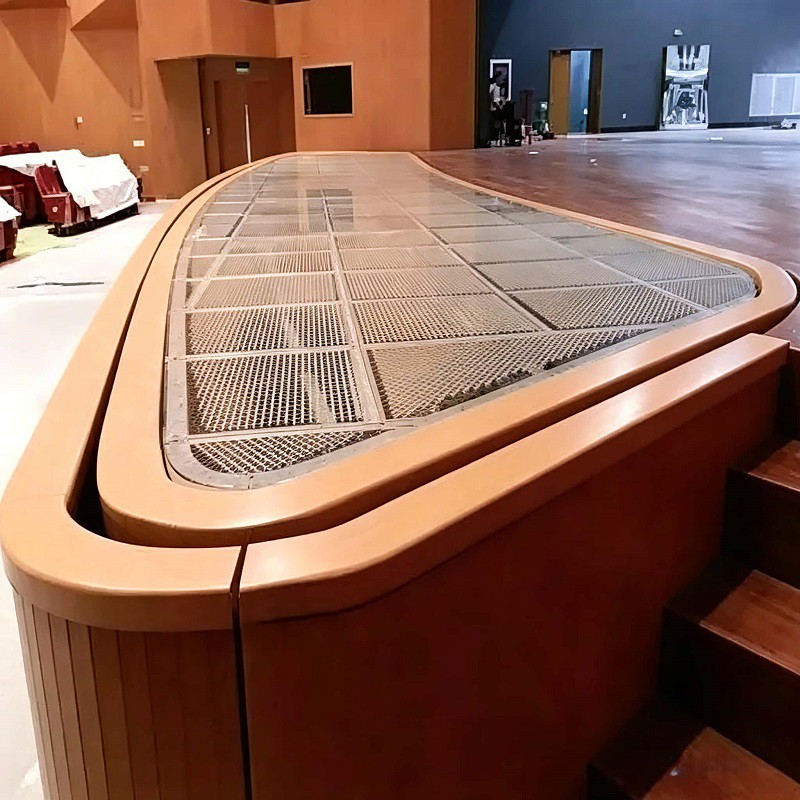
The Orchestra Pit Lift is a large-scale stage lifting platform installed at the front edge of a theatre stage, typically between the main stage and the audience seating area. It is designed to adjust the elevation of the platform, allowing the space to function as an orchestra pit, additional audience seating area, or extended stage.
By moving between different preset heights, the orchestra pit lift enables theatres to adapt their layouts to different performances and events. It can provide a dedicated area for orchestras and choirs, expand the audience seating capacity, or extend the main stage toward the audience.
Widely used in modern theatres, concert halls, opera houses, and multifunctional performance venues, the orchestra pit lift is an important solution for improving spatial flexibility and supporting diverse production requirements.
Product Description
The orchestra pit lift is a vertically moving mechanical platform designed to transform the space between the stage and the audience seating area.
Its operating height can be adjusted according to the intended use of the venue. In the lowered position, it forms an orchestra pit for musicians and choirs. At an intermediate height, it can align with the audience floor to accommodate additional seating. When raised to the main stage level, it extends the performance area and brings performers closer to the audience.
The lifting system can be designed with different drive technologies according to the required lifting capacity, travel distance, positioning accuracy, noise level, foundation depth, and maintenance requirements.
The choice of drive system should be determined by the specific project conditions, including the venue layout, structural requirements, operating frequency, and intended lifting performance.
Key Features
Three Functional Positions: Supports orchestra pit, audience seating, and extended stage configurations.
Flexible Space Conversion: Changes the function of the same area according to the requirements of different performances and events.
Precise Height Adjustment: Allows the platform to move to designated operating heights.
Multiple Drive Technology Options: Can be designed using rigid chain, hydraulic, screw-driven, or flexible gear-based systems, subject to project requirements.
Integration with the Main Stage: The raised platform can align with the main stage surface to extend the performance area.
Audience Capacity Optimization: The intermediate position can provide additional seating space when the orchestra pit is not required.
Enhanced Stage Design: Supports different stage elevations and more flexible performance arrangements.
Project-Specific Engineering: The lifting mechanism can be selected according to the required load, stroke, operating environment, and installation conditions.
Typical Applications
Theatres and Drama Productions
Transforms the orchestra pit into an extended stage, providing additional performance space and supporting different stage arrangements.
Opera Houses and Musical Theatres
Provides a dedicated orchestra area when lowered and allows the venue to change configurations when a live orchestra is not required.
Concert Halls
Accommodates orchestras and choirs while allowing the space to be reconfigured for other types of performances and events.
Multifunctional Auditoriums
Allows a single venue to accommodate performances, meetings, ceremonies, and other events with different spatial requirements.
Large-Scale Ceremonies
Extends the main stage toward the audience to support performer entrances, presentations, and large-scale stage arrangements.
System Configuration
The orchestra pit lift can be configured according to the venue's structural design, required travel distance, rated load, and operating requirements.
A typical project may include:
Lifting Platform: The structural platform that forms the orchestra pit floor, seating area, or extended stage.
Supporting Structure: Provides structural support for the platform and its intended loads.
Drive Mechanism: Raises and lowers the platform using the selected lifting technology.
Guidance System: Helps maintain stable platform movement throughout the lifting stroke.
Control System: Controls platform movement and designated stopping positions.
Safety Devices: The final configuration should incorporate suitable safety measures based on the selected drive system and applicable requirements.
Stage Integration: Coordinates the platform elevation with the main stage and audience floor levels.
The final configuration depends on the project drawings, pit depth, required lifting stroke, load requirements, drive technology, and control strategy.
Technical Specifications
|
Parameter |
Description |
|
Product Name |
Orchestra Pit Lift |
|
Equipment Type |
Vertical Lifting Platform |
|
Primary Function |
Orchestra Pit / Audience Seating / Extended Stage |
|
Operating Positions |
Lowered / Intermediate / Raised |
|
Lifting Stroke |
Customized According to Project Requirements |
|
Platform Dimensions |
Customized |
|
Rated Load |
To Be Determined According to Project Requirements |
|
Drive Technology |
Rigid Chain / Hydraulic / Screw-Driven / Flexible Gear-Based, Subject to Design |
|
Positioning |
Designated Height Positioning |
|
Control Method |
To Be Determined According to Project Requirements |
|
Installation Conditions |
Designed According to Venue Structure and Foundation Depth |
|
Stage Integration |
Main Stage and Audience Floor Levels |
|
Safety Configuration |
Determined According to the Selected Drive System and Applicable Requirements |
Safety Design
The orchestra pit lift carries performers, musicians, seating, or other designated loads. Its safety design must therefore be developed according to the platform configuration, drive technology, installation environment, and applicable requirements.
Important engineering considerations include:
Load-Bearing Structure: The platform and supporting structure should be designed for the specified rated load.
Controlled Vertical Movement: The drive and guidance systems should support stable movement throughout the lifting stroke.
Positioning Accuracy: The platform should reach the required operating heights to support the intended floor and stage configurations.
Platform Alignment: The raised position should be coordinated with the main stage, while the intermediate position should correspond to the intended audience floor level.
Drive-System Protection: Appropriate protective measures should be selected according to the chosen lifting technology.
Operational Control: The control system should support the intended movement sequence and operating procedures.
Maintenance Access: Inspection and maintenance provisions should be considered during the engineering design.
The final safety devices, interlocks, emergency functions, and other protective measures must be confirmed during project design. They should not be assumed to be identical across different drive technologies.
Performance and Operational Advantages
Three Functions in One Space
The platform can serve as an orchestra pit, additional audience seating area, or extended stage, depending on its operating height.
Improved Space Utilization
By changing the elevation of the same platform, the venue can adapt its layout without permanently dedicating the entire area to a single function.
Flexible Performance Arrangements
The raised platform can extend the stage toward the audience, while the lowered position provides space for an orchestra or choir.
Adaptability to Different Events
The intermediate position can support additional seating when a live orchestra is not required, helping the venue accommodate different event formats.
Multiple Drive Solutions
Different lifting technologies offer different advantages in load capacity, noise, positioning, lifting speed, and installation requirements.
Enhanced Stage Design
Coordinated platform elevation and stage movement can support multi-level performance layouts and more dynamic stage presentations.
Customized Solutions
Every theatre has different architectural conditions, pit dimensions, load requirements, and performance needs. The orchestra pit lift should therefore be designed around the specific requirements of each venue.
Customization may include:
Platform Dimensions: Length, width, and structural arrangement.
Lifting Stroke: The vertical travel required to connect the orchestra pit, audience floor, and main stage levels.
Rated Load: Determined according to musicians, performers, seating, scenery, and other designated loads.
Drive Technology: Selected according to load, stroke, positioning accuracy, noise requirements, installation depth, and maintenance considerations.
Operating Positions: Defined heights for orchestra pit, audience seating, and extended stage modes.
Control Functions: Configured according to the required movement sequences and venue operation.
Stage Integration: Coordinated with the main stage and surrounding floor levels.
Maintenance Provisions: Designed according to the selected mechanism and the venue's maintenance requirements.
For an accurate technical proposal, please provide the venue drawings, pit dimensions, required lifting stroke, rated load, target operating heights, available foundation depth, noise requirements, and preferred control arrangement.
Frequently Asked Questions
Q1: What is an orchestra pit lift?
An orchestra pit lift is a vertically moving platform installed between the main stage and the audience seating area. It changes elevation to create an orchestra pit, additional seating area, or extended stage.
Q2: What are the three main operating positions?
The three primary positions are:
Lowered Position: Forms the orchestra pit for musicians and choirs.
Intermediate Position: Aligns with the audience floor to accommodate additional seating, where the venue design permits.
Raised Position: Aligns with the main stage to extend the performance area.
Q3: What drive technologies can be used?
The source document identifies four drive categories: rigid chain, hydraulic, screw-driven, and flexible gear-based systems. Their suitability depends on the required load, travel distance, positioning accuracy, noise level, installation conditions, and maintenance requirements.
Q4: Which drive system is best?
There is no single best solution for every project. Rigid chain systems are described in the source as stable, quiet, precise, and suitable for shallow pits, but relatively expensive. Hydraulic systems offer high load capacity and low cost, but may involve oil leakage risks, higher noise, and more complex maintenance. Screw-driven systems offer precise positioning and self-locking performance, but may have lower speed and limited travel. Flexible gear-based systems support fast movement and long travel, but noise control and installation requirements need careful consideration.
Q5: Can the orchestra pit lift extend the main stage?
Yes. When raised to the main stage level, the platform can extend the performance area, subject to the venue's structural and operational design.
Q6: Can it provide additional audience seating?
The intermediate position can align with the audience floor and accommodate additional seating when the orchestra pit is not needed, provided the seating arrangement and load requirements are included in the project design.
Q7: What information is needed for a quotation?
Please provide the stage and pit drawings, platform dimensions, required lifting stroke, rated load, target operating heights, available foundation depth, preferred drive technology if known, noise requirements, and control-system requirements.
Hot Tags: orchestra pit lift, China orchestra pit lift manufacturers, suppliers, factory, LED Screen Frame, Lift Screen Frame, Single Point Hoist Stage, Horizontal Winding Curtain Machinery, Orchestra Pit Lift, Bi Parting Mechanism