

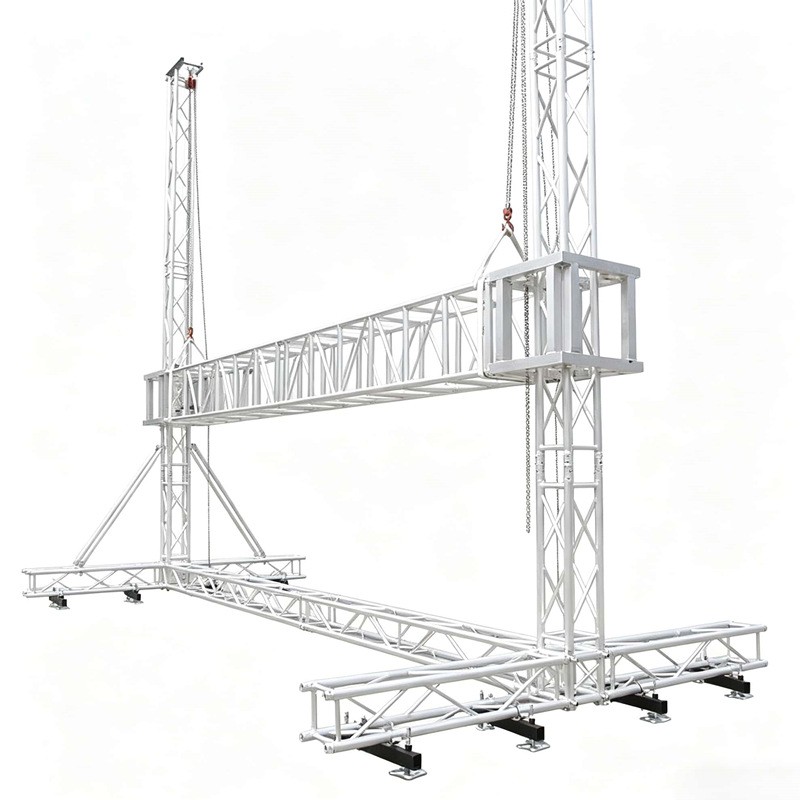
The LED Screen Support System is a modular structural solution designed to securely support and position large LED displays for concerts, live performances, exhibitions, press conferences, and other events.
Available in multiple configurations, including goal post trusses, ground support systems, and compact hand-crank frames, the system can be adapted to different screen sizes, installation environments, and event requirements.
Depending on the selected configuration, the structure can support suspended LED screens, freestanding display walls, or smaller screens for temporary event setups.
Product Description
The LED Screen Support System provides a stable structural framework for installing LED displays in indoor and outdoor event environments. Its modular design allows different structural components to be assembled and configured according to the project layout.
1 Goal Post Truss System
The goal post truss consists of two vertical side columns and a horizontal top beam, forming a portal-shaped structure. The system typically incorporates base supports and diagonal bracing to provide structural stability.
Key Features:
Suspended Screen Installation: LED screens can be hung beneath the top beam, helping maintain clear floor space.
Integrated Equipment Support: Depending on the structural design and verified load capacity, the system may accommodate additional lighting or audio equipment.
Modular Connections: Pin-type connections can facilitate assembly and disassembly for touring productions and temporary events.
Flexible Configuration: Suitable for installations requiring elevated LED displays.
Typical Applications:
Large concerts and live performances
Indoor and outdoor entertainment events
Touring productions
High-level suspended LED displays
2 Ground Support System
The ground support system uses vertically stacked and horizontally connected structural sections, with diagonal bracing incorporated where required by the design.
The LED display is supported by a freestanding framework rather than being suspended from an overhead truss.
Key Features:
Freestanding Configuration: Supports LED displays from a floor-based structure.
Modular Assembly: The framework can be configured into large display walls or assembled in sections, subject to the structural design.
Flexible Layout: Suitable for different stage backdrops and display arrangements.
Floor Load Considerations: The supporting floor must be capable of accommodating the system's total loads and load distribution.
Typical Applications:
Press conference backdrops
Fixed-stage LED display walls
Sporting events
Outdoor LED screens
Exhibition and event display installations
3 Simple Support / Hand-Crank Frame
The simple support system is designed for smaller LED displays and applications where a compact, relatively lightweight structure is preferred.
Depending on the configuration, it may use a single-column or double-column arrangement with a manually operated lifting mechanism and an extendable structure.
Key Features:
Compact Structure: Suitable for smaller display installations.
Manual Adjustment: A hand-crank mechanism can be used for lifting, subject to the selected model.
Easy Handling: A lightweight configuration can facilitate transportation and setup.
Cost-Conscious Solution: Suitable for projects with relatively modest display requirements.
Typical Applications:
Small-scale events
Weddings and celebrations
Compact indoor displays
Temporary promotional installations

1 Modular Structural Design
The system can be configured using different structural sections to suit the required screen arrangement and installation environment.
2 Multiple Installation Options
Goal post trusses, ground support systems, and simple support frames provide different solutions for suspended, freestanding, and smaller LED display installations.
3 Flexible Event Configuration
The support structure can be selected according to the event layout, screen position, available installation space, and equipment requirements.
4 Efficient Assembly
Pin-type connections are available for applicable truss configurations, helping simplify assembly and dismantling during touring and temporary events.
5 Material Options
Depending on the project requirements, the structure may be manufactured from aluminum alloy, carbon steel, stainless steel, or aluminum profiles.
Material selection should consider the required structural performance, environmental conditions, transportation requirements, and budget.
6 Adaptability to Indoor and Outdoor Events
Different configurations can be selected for indoor venues, outdoor performances, exhibitions, and other event environments. Outdoor installations require appropriate assessment of wind loads, stability, anchoring, and other site-specific conditions.
The LED Screen Support System can be configured for a variety of event and entertainment applications.
1 Concerts and Live Performances
A goal post truss can support the main LED screen, while additional ground-supported structures can be used for side screens, subject to the approved structural design.
2 Press Conferences and Corporate Events
A ground support system can provide a freestanding LED backdrop for presentations, product launches, corporate events, and press conferences.
3 Outdoor Music Festivals
Heavy-duty support structures may be selected for large outdoor LED displays. The final design should account for wind resistance, anchoring, ballast where applicable, and the actual site conditions.
4 Sporting Events
Ground-supported frameworks can be used for event display screens, subject to the required structural capacity and installation conditions.
5 Weddings and Private Events
Compact support frames may be suitable for smaller LED displays at weddings, celebrations, and private events.
6 Exhibition and Promotional Displays
The system can support LED displays used for exhibitions, brand presentations, temporary promotional installations, and event signage.

System Configuration
The system configuration depends on the selected structural type, screen dimensions, installation method, and project requirements.
Typical components may include:
Main Structural Frame: Vertical columns, horizontal beams, or modular support sections.
Base Supports: Structural bases used to support the framework.
Diagonal Bracing: Bracing components incorporated where required by the structural design.
Connection Components: Pins, connectors, and other fastening components appropriate to the selected system.
LED Screen Mounting Components: Screen attachment hardware compatible with the LED display and support structure.
Manual Lifting Mechanism: A hand-crank mechanism for applicable lifting-frame configurations.
Additional Equipment Supports: Provisions for lighting or audio equipment, where included in the approved design.
The final component list should be confirmed according to the project drawings, screen specifications, and required installation arrangement.
Technical Specifications
The following parameters should be confirmed before production and quotation.
|
Parameter |
Description |
|
Product Type |
LED Screen Support System |
|
Structural Configuration |
Goal Post Truss / Ground Support / Simple Support |
|
Main Material |
Aluminum Alloy / Carbon Steel / Stainless Steel / Aluminum Profiles |
|
Screen Dimensions |
Customized according to project requirements |
|
Overall Width and Height |
To be confirmed according to the installation layout |
|
Rated Load Capacity |
To be calculated and verified for the selected configuration |
|
Screen Mounting Method |
To be confirmed according to the LED display design |
|
Connection Type |
Pin-type or other suitable structural connections |
|
Lifting Method |
Manual hand-crank lifting, where applicable |
|
Indoor / Outdoor Use |
To be confirmed according to the design and site conditions |
|
Additional Equipment |
Lighting or audio support, where required and structurally verified |
|
Surface Treatment |
To be confirmed according to the selected material and operating environment |
Note: Actual dimensions, rated loads, lifting limits, and permitted configurations must be established through the final engineering design.
Safety Design
Safety is a critical consideration when supporting large LED displays, particularly for suspended installations and outdoor events.
The system should be designed and installed according to the actual screen weight, structural configuration, operating environment, and applicable local requirements.
Key considerations include:
Structural Load Verification: Confirm the total supported load, including the LED display, mounting hardware, and any additional equipment.
Connection Security: Ensure that structural connections and screen attachment components are suitable for the intended loads.
Stability: Verify the stability of the complete assembly, including bases, bracing, anchoring, and ballast where required.
Suspended Installation: Use appropriately rated suspension components and approved rigging arrangements.
Outdoor Wind Resistance: Assess wind loads and the required reinforcement or anchoring for outdoor installations.
Floor Load Capacity: Verify the supporting floor's capacity for ground-supported systems.
Manual Lifting Safety: For hand-crank systems, confirm the rated lifting capacity and the required load-holding and locking arrangements.
Safety components and installation procedures should be specified according to the selected model and the project's engineering requirements.
Performance and Operational Advantages
Multiple Structural Solutions
The availability of different support configurations allows the system to serve projects ranging from compact event displays to large concert LED screens.
Flexible Installation Layouts
The modular structure can be arranged to accommodate different screen positions and stage layouts, subject to the approved design.
Efficient Setup and Dismantling
Suitable modular connections can help improve assembly efficiency, particularly for touring productions and temporary event installations.
Material Selection Flexibility
Different structural materials offer different combinations of weight, strength, corrosion resistance, and cost, allowing selection according to project priorities.
Support for Customized Projects
Structural dimensions, configuration, and mounting arrangements can be developed around the actual LED screen and installation conditions.
Customized Solutions
Customized LED Screen Support Systems can be developed according to the specific requirements of each project.
Available customization options may include:
Overall structural width and height
Goal post or ground support configuration
Single-column or double-column simple support arrangements
Structural material selection
LED screen mounting arrangement
Base and bracing configuration
Manual lifting arrangement, where applicable
Provisions for additional lighting or audio equipment
Indoor or outdoor installation requirements
To evaluate a project accurately, please provide the following information where available:
LED screen width, height, and total weight.
Required screen installation height.
Suspended or ground-supported installation method.
Indoor or outdoor operating environment.
Available installation space and floor conditions.
Whether lighting or audio equipment will share the structure.
Project drawings, photographs, or other relevant technical documents.
These details will help determine a suitable structural arrangement and establish the parameters required for engineering verification and quotation.
Why Choose Our LED Screen Support System?
Flexible Product Configurations
Different structural arrangements are available to address the needs of concerts, exhibitions, press conferences, and other event applications.
Project-Oriented Design
The configuration can be developed around the actual LED screen dimensions, installation method, and site conditions.
Multiple Material Options
Aluminum alloy, carbon steel, stainless steel, and aluminum profiles can be considered according to the intended application and engineering requirements.
Integration with Stage Equipment
Where required and technically appropriate, the support structure can be coordinated with other stage equipment and event production systems.
Support for Project Communication
Technical information, screen parameters, and installation requirements can be reviewed to establish the basis for a suitable solution.
Frequently Asked Questions
Q1: What is an LED Screen Support System?
An LED Screen Support System is a structural framework used to support and position LED displays for concerts, exhibitions, press conferences, and other events.
Q2: What types of LED screen support structures are available?
Common configurations include goal post trusses, ground support systems, and simple support frames with manual lifting mechanisms.
Q3: What is the difference between a goal post truss and a ground support system?
A goal post truss typically uses two vertical columns and a top beam to create an elevated structure for suspended screens. A ground support system uses a floor-based framework to support freestanding LED display walls.
Q4: Can the support system also carry lighting or audio equipment?
Some configurations can accommodate additional equipment, but this depends on the structural design, total load, connection arrangement, and verified load capacity. It must be confirmed before use.
Q5: Can the LED screen support structure be customized?
Yes. The structural configuration, dimensions, materials, and mounting arrangements can be developed according to the project requirements.
Q6: Can the system be used outdoors?
Certain configurations can be designed for outdoor applications. Wind loads, anchoring, structural stability, and site conditions must be assessed before installation.
Q7: How do I select the appropriate support system?
Provide the LED screen dimensions and weight, required installation height, preferred support method, indoor or outdoor conditions, and available installation space. These details can be used to determine the appropriate configuration and engineering requirements.
Hot Tags: led screen frame, China led screen frame manufacturers, suppliers, factory, LED Screen Frame, Lift Screen Frame, Single Point Hoist Stage, Horizontal Winding Curtain Machinery, Orchestra Pit Lift, Bi Parting Mechanism